
Reading Hancock County Property Tax Records
Hancock County property tax records live in two systems. The Board of Tax Assessors decides taxability, sets fair-market value, applies the state assessment framework, handles exemptions, and prepares the annual digest. The Tax Commissioner sends the bills and collects them. Value questions go to the assessor. Payment, receipt, or delinquency questions go to the collector.
| Field | What It Shows | Where |
|---|---|---|
| Fair-market value | The assessor's estimate of full value under Georgia law | Assessor card and digest |
| Assessed value | Ordinarily 40% of fair-market value before exemptions | Assessor card |
| Exemptions | Relief approved for the parcel and tax year | Assessor and filing records |
| Tax bill and status | Charges, payments, balances, or delinquency for a year | Tax Commissioner |
| Liens or executions | Separate enforcement records for unpaid tax | Clerk's general execution docket |
Georgia law defines fair-market value as the price a willing buyer and willing seller reach in an arm's-length deal. The ordinary assessed amount is forty percent of that figure. Exemptions then shrink the taxable base. A deed's consideration is a separate fact, not a label for value. Paying a bill proves no title. It clears no boundary. Nor does it erase a recorded lien.
Keep each year intact when you copy records. A payment screen can show one cycle while the appraisal card shows another, and a newly recorded deed can post before either system updates its owner line. Save the bill year, assessment year, parcel number, owner spelling, and search date with every copy. Those labels stop an old bill from being read as today's balance.
Hancock County Property Tax Offices and Access
The Hancock County Board of Tax Assessors sits at 12630 Broad Street in Sparta, lists 706-444-5721, and keeps weekday hours of 8:30 a.m. to 5:00 p.m. The Tax Commissioner shares that address, lists 706-444-5148, and publishes the same Monday-through-Friday hours. Both offices answer questions in person. Call first when a deadline or account status matters.
Tax Assessor
Ask about fair-market value, the assessment card, digest entries, exemptions, returns, and valuation notices.
Tax Commissioner
Ask about bills, payments, receipts, delinquency, homestead filing intake, and current tax-sale procedures.
Online access is not the only route. Both offices take walk-in questions. A caller can confirm mail or email intake first. A written request for an existing assessment card, bill, or notice can also travel the Georgia Open Records Act route. The agency need not create a new analysis. It provides the record it already holds, subject to lawful exemptions and costs.
The assessor's office page confirms the local appraisal and digest role.

Values and exemptions belong with the assessor. Collection questions route to the Tax Commissioner, whose bill and payment page identifies the office that collects the tax.

An assessment search and a bill search are different tasks. The two offices' pages show why they must not be treated as one function.
Hancock County Property Tax and Forty Percent
The Georgia Department of Revenue valuation guidance supplies the statewide framework behind Hancock County property tax records. The county estimates fair-market value first. Real property is then generally assessed at forty percent. A parcel with exemptions or a special valuation can carry a different taxable figure. Millage then applies by jurisdiction and tax year.
The DOR valuation page gives the official Georgia context for these terms.
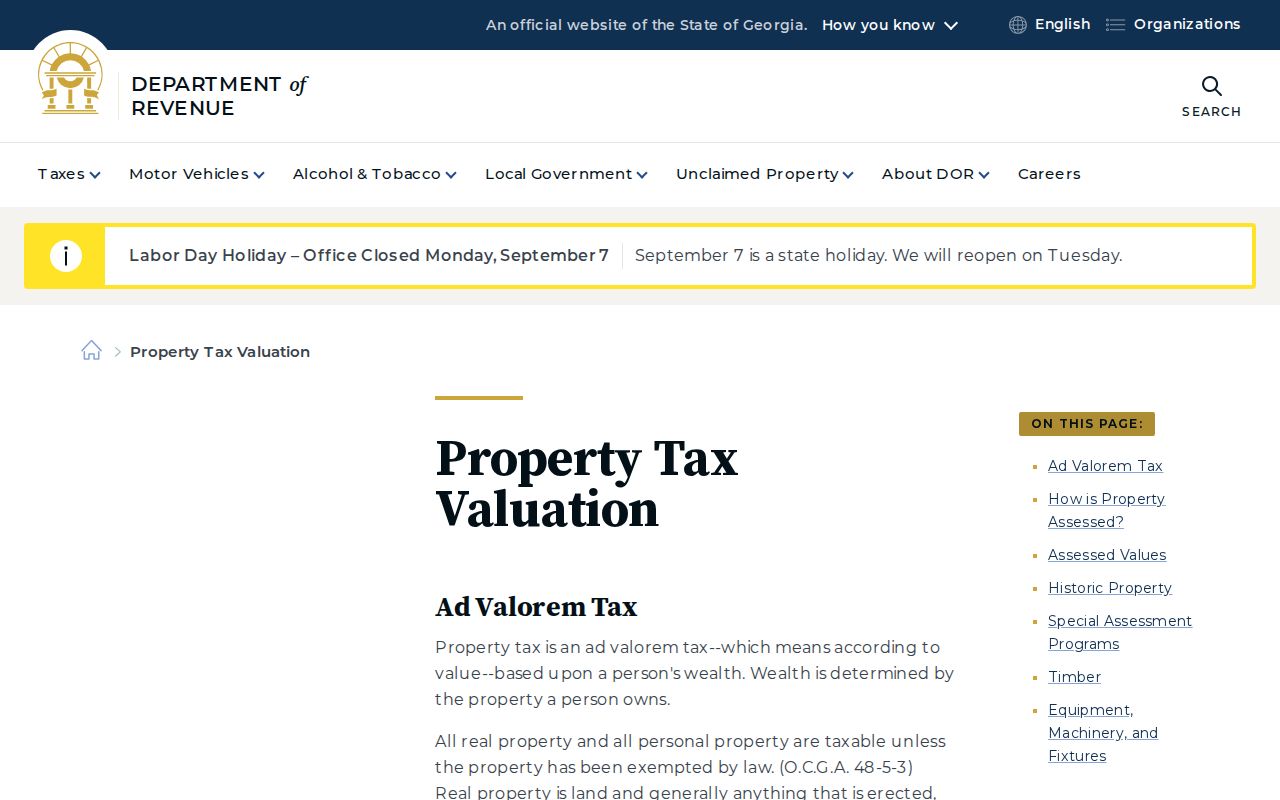
Hancock's own card supplies each parcel's year and values.
- Fair-market value
- The estimated full value under Georgia's willing-buyer and willing-seller standard.
- Assessed value
- The statutory share of fair-market value used as the starting point for taxation.
- Millage
- A tax rate expressed in mills and applied to the taxable assessment.
- Tax lien
- A claim tied to unpaid tax and recorded through the county's execution process.
Hancock's legacy qPublic page warns that its figures reflect the most current published digest. That phrase promises no live ledger. Record the tax year and data date shown with any figure.
Millage is a separate layer again. The digest establishes values. Adopted rates and districts turn the taxable assessment into a bill. Never infer a mill rate from an old bill. Ask the collector or consult the official tax-year material for the jurisdictions on the account.
Hancock County Property Tax Revaluation Fieldwork
The assessor's public notice said Hancock County contracted with GMASS for countywide field inspections running September 2025 through April 2026. Appraisers were to carry identification and use marked vehicles. That field period has passed. Confirm revised cards and notices with the assessor. Assume nothing.
The episode teaches a records lesson. An inspection period, a value notice, the digest publication, and the bill are separate events. Save the notice date, parcel number, old value, proposed value, and printed appeal deadline. Those details help the office match the cycle. They also stop a newer proposed value from being compared with an older bill as if both came from the same tax year.
Hancock County Property Tax Exemptions
Hancock County spells out its homestead rules plainly. A claimant generally must own and occupy the home on January 1, then file between January 1 and April 1 for the exemption to apply that year. The county's guidance points to the standard exemption under O.C.G.A. §48-5-44, along with separate categories for age, school, disabled veterans, and surviving spouses. Dollar figures on an older legacy page should be read with care, since they do not bind the current tax year. Before filing, confirm your eligibility and pull the live form for the year you claim.
- Standard owner-occupied homestead relief
- Age-based county or school exemptions
- Disabled-veteran and qualifying surviving-spouse relief
- PT-283A agricultural current-use valuation
- Freeport relief for qualifying personal-property inventory
An ordinary homestead exemption renews on its own while ownership and eligibility stay unchanged. Never assume it carries over after a deed. Hancock also publishes PT-283A current-use guidance. That program sets an April 1 deadline. It also requires a ten-year qualifying-use covenant. Part of that covenant is recorded with the deed. Its acreage, ownership, use, and breach rules are detailed. Ask the assessor to review the current application before anyone relies on a legacy summary.
Note: A tax-card exemption label records an assessment treatment. It is not a finding about present title or a promise of future eligibility.
Check a Hancock County Tax Bill
The official Hancock tax search and payment portal is the county's online route for paying a Hancock County tax bill. The Tax Commissioner links it directly. If it stalls, a fallback works. Pull the parcel identifier from the assessor card first. Then contact the Tax Commissioner for an existing bill, a ledger entry, or a receipt for the year you need.
- Find the parcel in qPublic and copy its identifier exactly, including spaces or punctuation.
- Open the tax portal and search the parcel. If the screen is blocked, call the Tax Commissioner with the parcel and tax year.
- Match the owner, site, year, and bill before reading charges, payments, or balance.
- Compare exemptions with the assessor card. Ask the Clerk about any execution or lien record rather than inferring one from a balance alone.
Georgia DOR guidance puts the normal due date at December 20 unless local law sets another date. It also spells out a separate postmark rule before interest starts. That is a statewide rule, not a Hancock deadline. The bill and the Tax Commissioner remain the authoritative sources for the account and year. Just paid? Keep the confirmation and ask when the public status refreshes. A portal balance and the office ledger can briefly disagree. Let the record settle before chasing the difference. Never pay through an unverified link. Leave bank or card details out of any open-records request. Hancock's official online payment route appears on the tax portal's landing page.

The screen identifies the correct Hancock system. The parcel, tax year, and payment status still have to be checked inside the live account.
Hancock Delinquent Tax Records
Hancock County publishes no current tax-sale calendar or searchable sale list. The reliable fallback starts with the Tax Commissioner. Ask whether the parcel is delinquent, scheduled, postponed, redeemed, or removed. Then request the current published notice. The Clerk's general execution docket and real-estate index come next. Search both for executions, tax deeds, sheriff's deeds, assignments, releases, and redemption instruments.
County Code §4-008 sets the timing and manner. Tax sales follow Georgia law for sheriff's sales of state taxes. Redemption is referenced under O.C.G.A. §48-4-1 et seq. A sale notice is not a full legal description. A tax deed can also remain subject to redemption or later proceedings. Read the recorded instrument and later filings first.
Tax-sale caution. A delinquent account or sale list does not establish the current owner, clear title, or show that redemption has ended.
Appeal Hancock County Assessments
Hancock's guidance gives taxpayers 45 days from the assessment notice to file an appeal with the Board of Assessors. The clock matters. Grounds include taxability, value, uniformity, and denial of an exemption. The bill amount is not a normal ground. The Board reviews the filing first. An unresolved matter can then go to the Board of Equalization, with arbitration or court review available under current law as further routes.
The official Georgia PT-311A appeal form sets the statewide filing framework. Confirm how Hancock accepts the current form. Keep proof of timely delivery. Attach evidence aimed at your chosen ground, whether that is the notice, the parcel card, photographs, factual property corrections, comparable sales, or exemption documents. Do not send the appeal to the Tax Commissioner. That office collects the bill rather than setting value.
Appeal window. File with the Hancock County Board of Assessors within 45 days of the assessment notice and verify the notice's printed deadline.
The captured PT-311A page points to Georgia's official assessment-appeal form and instructions.
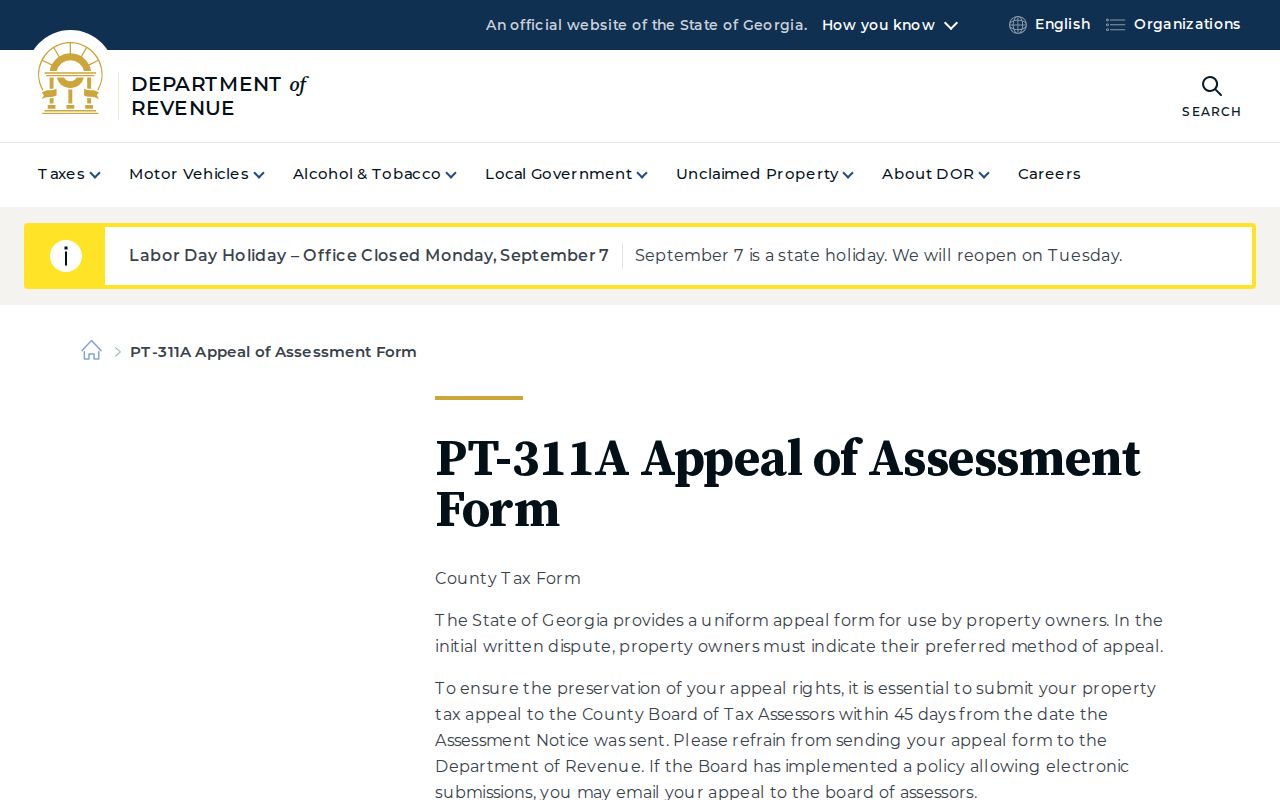
The form supports an appeal, but the notice date and the Hancock filing receipt control the timeliness record.