
Follow Hancock County's Address-to-Owner Route
Two Hancock County offices split the work. The Board of Tax Assessors keeps ownership information current for assessment and the published tax digest. The Clerk of Superior Court records the deeds that actually convey land. Start with the tax card. Then confirm with the newest matching deed. Keep the deed's recording date separate from the digest year, because a fresh transfer often shows up in the Clerk's index before the assessor's tax card catches up.
- Search the exact situs in the Hancock qPublic parcel application and copy the parcel number, owner spelling, digest year, and legal description.
- Search that owner as a grantee in the GSCCCA Real Estate Index, limited to Hancock County and a sensible date range.
- Open the newest likely conveyance and match its parcel reference, acreage, legal description, and prior owner to the assessment parcel.
- If the grantee is a company, estate, or trust, use the relevant entity or probate record for context, but keep the deed as the land-interest record.
- When the two sources disagree, ask the Assessor about the card date and the Clerk about the newest recorded instrument.
Start the Hancock County Owner Check at qPublic
The Hancock qPublic page links the county's assessment search and states that its information reflects the most current published tax digest. The live parcel card needs JavaScript, so the exact owner-field labels, ownership-history controls, and any refresh stamp depend on what the current card displays. Record whatever labels appear rather than assuming a set format.
If the portal will not load, call the Board of Tax Assessors at 706-444-5721 or visit the office at 12630 Broad Street in Sparta. Ask for the assessment card tied to a parcel number or an exact situs address. The office maintains ownership records, exemptions, valuations, and the annual digest. It does not record deeds.
Begin at the official Hancock qPublic page, which points visitors to the county's assessment search.
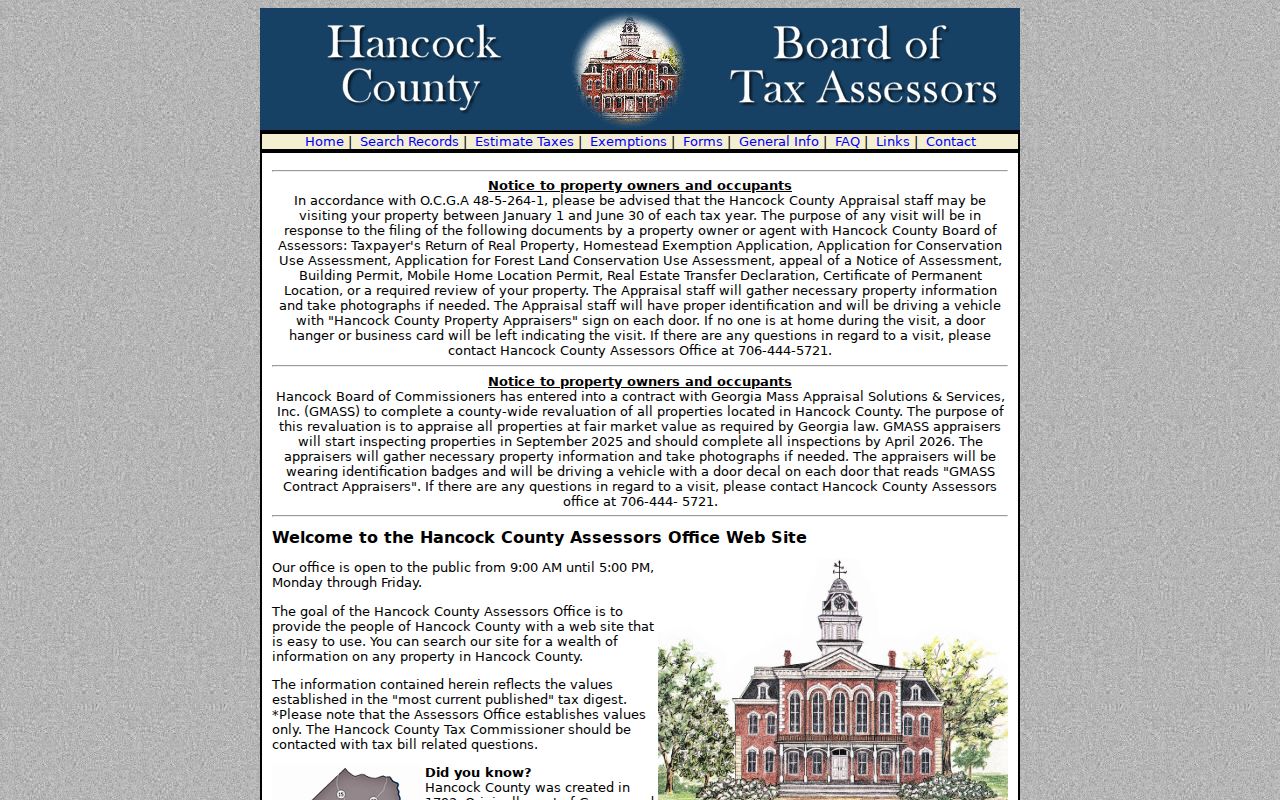
The official qPublic page confirms the assessment doorway and its digest-based context. It still does not replace the newest recorded deed for proof of ownership.
Compare Hancock County Property Owner Sources
No single public screen answers every ownership question in Hancock County. Use each source for the fact it was built to maintain, and reconcile names through the same parcel number and legal description.
| Source | Owner Info It Gives | Access |
|---|---|---|
| Hancock qPublic assessment card | Published-digest owner or taxpayer entry, situs, parcel key, and related assessment facts when displayed | Online; Assessor counter or phone fallback |
| Clerk and GSCCCA deed record | Grantor, grantee, recording date, book/page or instrument number, and legal description | Statewide index; Clerk counter for copies and older material |
| Georgia eCorp business search | Entity name, control number, status, registered agent, officers, and filing context | Free official state search |
| Hancock Probate Court | Estate or fiduciary authority that may explain an executor or administrator deed | Office inquiry at the courthouse |
The name on a tax bill is not always an occupant. A mailing address can belong to an owner, trustee, company, or a tax-payment contact living elsewhere. This workflow identifies recorded or assessed ownership interests in Hancock County property records, not whoever happens to be present at the address.
Trace the Hancock County Name to the Newest Deed
Once qPublic supplies an owner lead, move to the Georgia Real Estate Index. Its name search exposes many filters. These include party type, instrument type, county, and date range. Name fields and a neighboring-county option appear too, along with page count and a table display. Search Hancock County narrowly first. A result may give a book and page or an instrument number. Use that reference to request the recorded image or a Clerk copy.
Never accept a surname match alone. Compare the full legal description, acreage, and parcel reference. Check the grantor, the grantee, and any related plat before drawing a conclusion. GSCCCA describes statewide coverage. That coverage includes transactions for all counties since 1999, and older material is still being added. Those statements do not promise that every Hancock County deed image is online.
Read Hancock County Ownership Terms Precisely
Small differences in record labels change what an ownership result means in Hancock County deed records. Preserve the exact term and date instead of rewriting every name as simply the owner.
- Owner of record
- The person or entity named in the relevant office's current record; on an assessment card, it remains tied to the published digest.
- Grantee
- The party receiving the interest described in a recorded instrument.
- Vesting
- The deed language describing how an interest is held, which may involve multiple people, a trust, or an entity.
- Situs address
- The physical-location address used to identify the land, which can differ from the owner's mailing address.
Resolve Hancock County Companies, Trusts, and Estates
When a Hancock County deed names a Georgia company, search the Secretary of State's eCorp system. Search by exact business name or control number. The official tool also searches by registered-agent or officer name. The entity record explains who stands behind the name, and it does not transfer land or replace the deed. For a trust, read the vesting and the trustee capacity stated in the instrument itself. Do not assume the beneficiary is public.
An executor, administrator, or estate name may call for Hancock County Probate Court context. That court sits at 12630 Broad Street in Sparta. It can help locate an existing estate file. Use the file to understand who holds authority. Then return to the recorded deed to confirm how the property was conveyed.
Use Every Hancock County Ownership Access Channel
Online searching is only one channel. qPublic handles the assessment side, while GSCCCA runs the statewide deed index. The Clerk's courthouse counter remains the full-service option. It handles recordings, images, older deed books, and certified copies at 12630 Broad Street, 706-444-6644, Monday through Friday from 9:00 a.m. to 5:00 p.m. Hancock also appears on the Georgia eCertITY list of participating counties. The service requires a universal account before certified copies can be ordered that way.
A written Georgia Open Records Act request works well for a specific existing record. Name the parcel, the document type, and the date range. Then send it to the proper custodian and ask for electronic delivery where that is practical. State guidance calls for production within three business days when possible. Or the office sends a written account of timing, estimated cost, or an exemption. Older ownership clues also surface at Georgia Archives and the Sparta Public Library. Any newspaper or archive lead, though, must be traced back through the official deed chain before it counts.
Keep the assessor card, the newest deed reference, and any custodian response in one file. Write the owner's spelling exactly as recorded, along with the digest year, the deed's recording date, and the legal-description match. When the card and the deed disagree after a recent transfer, ask the assessor how ownership changes enter the next published digest. Do not guess between the two. That dated comparison points to the best-supported current owner of record. It also explains why an older public entry may still show.
Monitor New Hancock County Filings with FANS
The Hancock Clerk links directly to Georgia's Filing Activity Notification System, known as FANS. It sends forward-looking notices when qualifying filed or indexed records match criteria you select. This is the official notification route. However, it cannot promise that every filing gets caught. It also cannot promise that every index entry is complete.
Start by saving a baseline with the current owner spelling and instrument number. Then set your notification criteria. Compare any alert against the actual recorded document before acting on it. An unexpected notice belongs at the Clerk's counter. Do not draw a conclusion from an email alone.
Know What a Hancock County Owner Search Leaves Open
The question of who owns this property has real limits. An assessment entry can lag behind a deed. An index can omit an image. A matching name can belong to a different tract entirely. Neither the GIS map nor the tax card substitutes for a title examination. Georgia Safe at Home lets a participant use a designated public address and seals the confidential voter address behind it. Protected location data must never be sought or republished.
Lawful use. Use Hancock County property owner records for deed checks, purchase diligence, estate work, and boundary questions, never to target or harass a person.