
Hancock County Current Owner Record Card
The Hancock County Board of Tax Assessors keeps ownership records current for assessment work. Its qPublic landing page carries one clear limit. The data reflect the most current published tax digest. Nothing newer appears there. The record card here is a field-reading model rather than a sample parcel. Treat the field labels as illustrative until you open the live application yourself.
| Owner name | The taxpayer or owner entry published with the assessment parcel |
|---|---|
| Mailing address | Where assessment and tax mail is directed |
| Situs | The physical property address, when assigned |
| Last sale date | A transfer lead that must be checked against the deed |
| Deed reference | Book/page or instrument link if the card provides one |
An owner of record is simply the party named in whichever record you are reading. On an assessment roll, that means the party carried for tax administration. It does not guarantee live title. The situs is where the property sits. The mailing address is where notices go. It may be a remote office for an entity, an estate, a farm, or an owner who gets mail elsewhere. A distant mailing address is common and settles nothing about occupancy.
Read every identifier on the card before accepting the name. Rural land may lack a familiar street address, and roads can share similar numbers. Acreage, the legal description, the map reference, and the deed citation separate close results. A parcel may have been split or combined. Its current assessment identifier may not appear word for word in an older deed. The assessor's office can explain how the roll links old and new assessment entries.
Value and exemption lines help confirm the right card is open. They do not define ownership. Treat them as cross-checks only. A different acreage or land class can point to a neighboring tract. It can also point to a later parcel change. Go back to the property search results. Weigh every plausible match before you record the name.
How Fresh Is the Hancock County Current Owner Record?
Hancock publishes no fixed number of days between deed recording and assessor update. The sound test uses two dates. One is the newest deed's recording date. The other is the assessment card's digest year or update label, if one is shown. A conveyance newer than the published roll can leave the deed naming a new grantee. Meanwhile the tax card still carries the prior taxpayer.
Never guess at the lag. Save the search date and the exact owner spelling. Ask the Hancock County Tax Assessor how a recent transfer is reflected between digest cycles. The office lists 706-444-5721 and weekday hours from 8:30 a.m. to 5:00 p.m. A correction request should name the parcel, card year, instrument, and recording date.
Other events can explain a mismatch too. A corrective deed may fix a name or description without changing the beneficial owner. An executor's deed can follow an estate case. A security deed records collateral, not a sale to the lender. Compare instrument type and grantee language first. Only then treat the newest date in a name search as the newest transfer.
The two offices answer different halves of the question. Ask the assessor which digest the card uses. Ask the Clerk whether a newer conveyance has been indexed. Ask also whether its image is available. Keep both replies with your saved records rather than silently picking one date.
Recent-sale check. The published assessment roll can lag a sale; the newest valid recorded conveyance is the more current ownership evidence.
Find Hancock's Current Owner Entry
The official Hancock qPublic landing page links to the Schneider parcel application. Start with an exact street number and road name. An owner surname works too. So does a parcel identifier from a bill or deed. Keep the punctuation and leading zeroes intact. The official Hancock parcel-number pattern is not documented here.
Once the parcel card opens, write down the displayed owner, mailing address, situs, acreage, parcel number, legal description, sales or deed reference, exemptions, value fields, and digest year. Do not claim a field that is absent. The live property search may be blocked. Then call the assessor. Or ask for the assessment card in person, by confirmed mail or email intake, or through a focused Georgia Open Records Act request.
A written request works best when it seeks a known record rather than a custom conclusion. Give the site address, the parcel number if known, the owner spelling, and the year. Ask for the assessment card. Also ask for any transfer reference carried with it. Request electronic delivery where practical. Georgia guidance calls for a response within three business days. Or it calls for an explanation of timing, cost, or exemption. That reply may be an estimate rather than final production.
The assessor's landing page shows the official route and its current-digest warning.
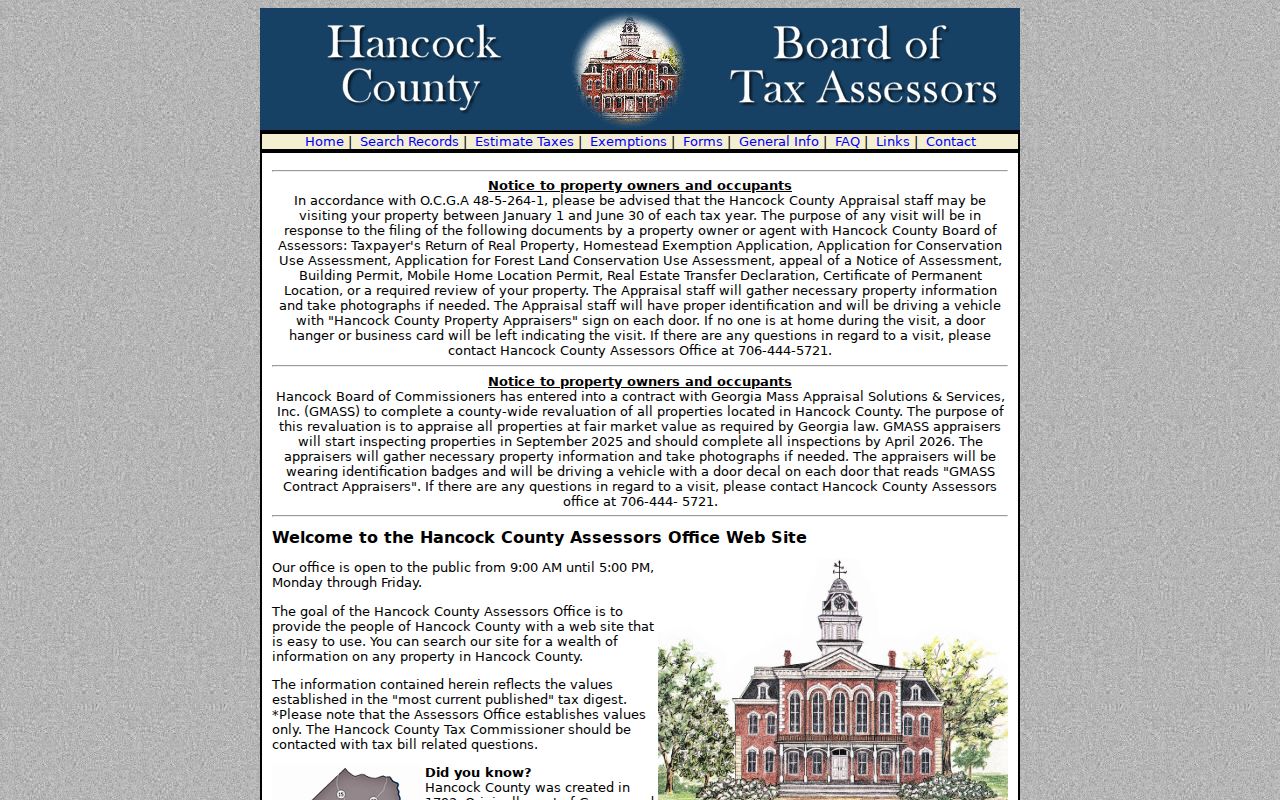
The image identifies the official source. The live parcel card still supplies the owner and date that must be checked.
Hancock County Current Owner Addresses
Two addresses appear in Hancock County property records, and each answers a different question. The situs address pinpoints the land itself. The mailing address simply tells the assessor and tax office where to send notices. Those two lines can differ without signaling any error. The owner of record may prefer a post office box, an office, a second home, or the address of a trustee handling an estate.
- Owner of record
- The party named on the assessment roll or deed being read.
- Assessment roll
- The county's tax-administration record for parcels, owners, values, and exemptions.
- Situs address
- The physical location assigned to the parcel, when one exists.
- Recording lag
- The interval in which a recorded transfer may not yet appear in the published digest.
Hancock County's rural layout and lake shorelines reward careful matching. A Sparta mailing address alone tells you little. Communities like Jewell, Culverton, Mayfield, Devereux, and Linton appear in owner records as place names. They are not separate systems of their own. Treat them as search clues only.
Lake Sinclair parcels raise the stakes. A tax card may orient a tract toward a road, a shoreline, or a neighboring lot. Yet that sketch is no survey. To tie a current owner entry to the exact land, you may need the recorded plat. An easement or the full deed description may also help. Shore access and road rights never follow from a mailing line or an aerial view.
Sparta is the county's only incorporated city in the Census place table. Even so, a Sparta postal address can still reach land beyond the city limits. That split matters for zoning review. Zoning may fall to city or county staff depending on location. Ownership itself stays a county question, answered through the assessor and the recorded deed.
Confirm Hancock's Present Property Owner
The Georgia Consolidated Real Estate Index connects the assessment name to the recorded instrument. Set the search to Hancock County and query the owner as grantee. A candidate deed must match the land through its legal description, parcel reference, acreage, prior owner, or recorded plat. A similar name alone proves nothing.
- Read the owner of record and data year on the qPublic assessment card.
- Search that party as grantee in Hancock County and locate the newest matching conveyance.
- Compare the legal description, parcel reference, recording date, and grantee with the card.
- Ask the Clerk for the image or a certified copy when online access is incomplete.
The Hancock County Clerk of Superior Court records land instruments at 12630 Broad Street in Sparta. The office lists 706-444-6644 and weekday hours from 9:00 a.m. to 5:00 p.m. Its counter is the fallback for an older book, a missing image, or a certified copy. Keep in mind that the index is a finding aid, not a title opinion.
Verify each candidate instrument closely. Check grantor, grantee, execution date, and recording date. Also check instrument type, book and page or instrument number, and any attached exhibit. A same-name match is weak standing alone. The deed must describe the same land. It must also show a conveyance to the party now claimed as owner. Where authority flows through a trust or an estate, the instrument may point to another record. You also have to read that record.
Online coverage has its limits. GSCCCA publishes statewide date statements. But those statements do not promise that every Hancock image exists for every year. Free full access is described at Superior Court clerk offices. Meanwhile, some online functions require an account or a fee. Confirm the live terms before relying on any cost or access level.
Hancock County Current Owners in LLCs and Trusts
An owner of record can be a company, a trust, or an estate. Hancock County deeds list these owners often. Copy the full name and every suffix exactly as the deed spells it. For a business, the Georgia Corporations Division eCorp search offers several entry points. It takes a business name, control number, registered-agent name, or officer name. The result can open an official contact route. But it cannot rewrite the deed. Nor can it turn a registered agent into the parcel's personal owner.
Trust records run thinner. Deed indexes usually carry only the trustee's name. Search the trustee's name, then read the deed's vesting language. An estate transfer may point to the probate file for an executor's or administrator's authority. In every case the newest matching recorded instrument is the confirmation that counts.
Corporate status and land title answer different questions. An entity lookup may show a company as active or dissolved. It may also show one represented by a registered agent. That status does not convey land. Only the recorded instrument answers the transfer question. Keep the corporate control number with your notes. It keeps two similarly named firms from being merged in a Hancock County property search.
Note: Similar entity names are common, so match control numbers, deed text, and parcel descriptions before linking a company to Hancock land.
Monitor New Hancock Owner Filings
The Clerk connects searchers to the GSCCCA Filing Activity Notification System, known as FANS. Think of it as a forward-looking alert service. It flags qualifying filings that match criteria you select. It is not a current-owner database, and it does not promise that every record is complete, accurate, or timely.
Start with a solid baseline. Save the current deed's instrument number and the exact owner spelling. Add notification criteria where they fit your parcel. When an alert arrives, compare it against the actual recorded document before drawing any conclusion about a new owner of record. Contact the Hancock County Clerk if a filing looks unexpected.
The service earns its keep after that. Check the filing type, county, parties, and instrument image when an image is available. Recent is not the same as new. A security deed, cancellation, lien, or corrective filing affects an existing interest rather than replacing the owner. Keep the saved baseline beside every alert date.
Use Hancock Owner Records Lawfully
A published mailing address gives you a way to reach the owner of record about a purchase. The same address works for an easement, a boundary question, or an estate matter. Keep the message about the property itself. Georgia law protects participants in its Safe at Home program. These participants may substitute a designated address in public records, so a confidential home address stays sealed. Never try to uncover the address behind a substituted line.
The Georgia Open Records Act guidance backs requests for existing public records. Agencies can redact exempt data. They do not have to build a new report for you. Name the parcel, the record type, and the date range in your request. If a record is withheld, ask for the legal basis. Also ask for any segregable public part.
Stay measured and transparent. State the property and your reason for writing. Give the owner a clear reply route, and honor any request for no further contact. A public record is not permission to intrude, threaten, or republish protected details.
Lawful use. Use Hancock County owner information only for legitimate property research; never use it to stalk, harass, threaten, or expose protected addresses.