
Reconstruct Hancock County Former Owners by Transfer
Start with the newest plausible deed and log each step back in a chain table. One row per transfer works well. The example structure is only a worksheet, not a claim about any sample parcel. Fill every row from the actual instrument. Confirm the same legal description appears before the name counts.
| Transfer Date | Grantor to Grantee | Deed Type | Book/Page |
|---|---|---|---|
| Newest verified recording | Prior holder to current grantee | Copy exact instrument heading | Copy the citation |
| Next earlier recording | Earlier holder to prior holder | Note warranty, quitclaim, estate, tax, or correction | Copy the citation |
| Earlier book era | Names as written in the page | Read the granting clause | Include volume and image page |
| Unresolved link | Candidate names only | State why it is uncertain | List the next record to seek |
A grantor becomes the next backward-search name only after the tract matches. Names alone are not enough. A same-name result with different land calls does not belong in the chain. Tag each row with a confidence note. Verified means both align. Probable means a strong citation still lacks an image, while unresolved covers missing pages or conflicting acreage. Scope matters too. Record whether the transfer covered the whole tract, carved out a smaller parcel, reserved an easement, or conveyed only a limited estate.
Modern Hancock County Ownership History Has Two Cutoffs
The GSCCCA real-estate index reaches back to January 1, 1990 and runs to a rolling current date. Coverage keeps moving. A separate GSCCCA statement describes all-county transactions since January 1, 1999, with material from 1993 through 1998 still being added. Neither statement fixes the first online result for a particular Hancock County parcel. Nor does either guarantee an image.
Log the earliest result actually returned. The Clerk counter and the Archives sit apart. They hold the older layer. The practical endpoint for former owners depends on the names searched, instrument indexing, image participation, tract changes, and surviving books, so no chain should be claimed back to one advertised year. Test alternate spellings and fiduciary roles before declaring an online gap.
Coverage checkpoint. State the tested search's earliest result, not a universal online cutoff. Older Hancock books begin in the 1790s but vary in indexing and condition.
See the Hancock County Name Index Before Going Back
The visible party-name form holds Hancock County and a date range steady while you vary the surname, given name, party role, and instrument type. Variants matter. Initials, suffixes, prior surnames, estates, trustees, and business names all hide in the index. The GSCCCA grantor-grantee screen starts the modern chain.
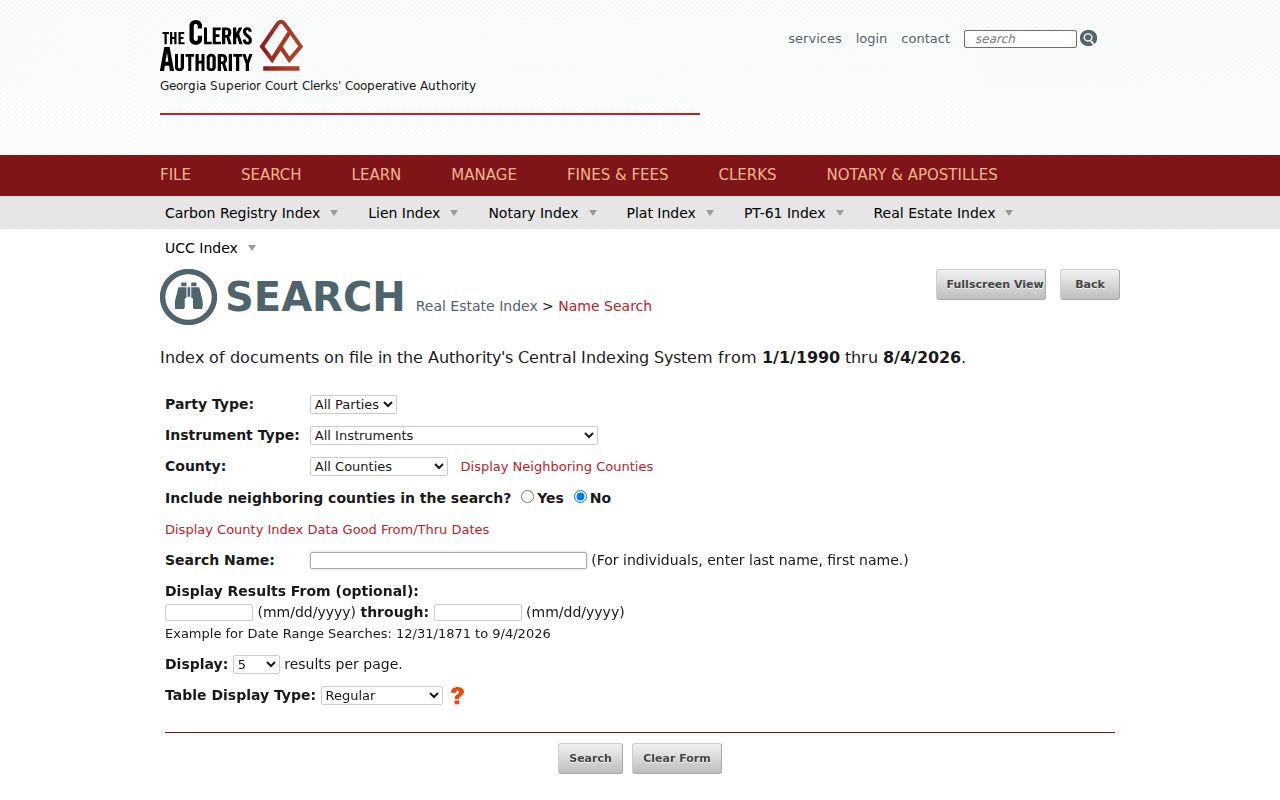
Save the query terms and the returned page count. A later researcher can then reproduce the step and spot a changed index. The broader real-estate index landing page gives the coverage context.
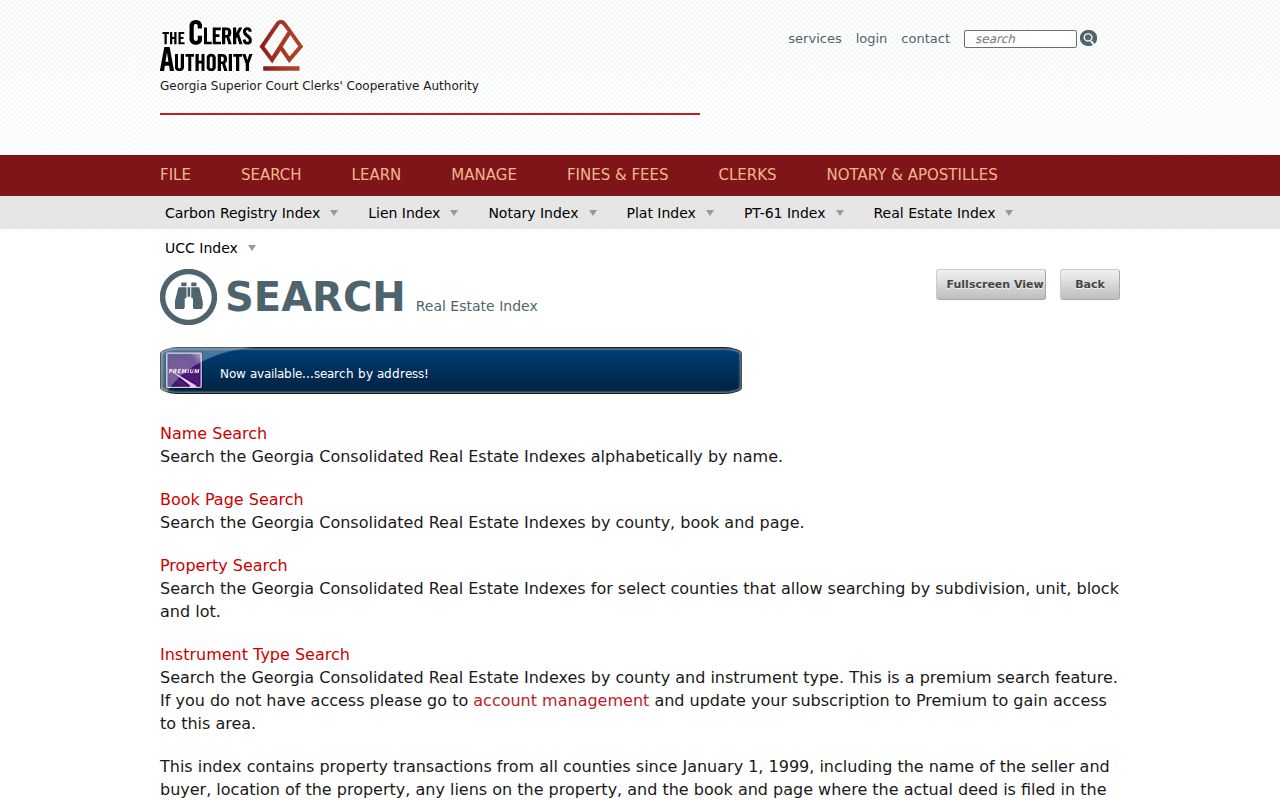
Keep the coverage note apart from the earliest deed.
Walk Hancock County Prior Owners Backward
Start with the newest deed tied to the parcel. Then work backward. Move from each grantor to the instrument that first gave that party the land. Hancock County chains read in reverse time. The focus stays on identity of the tract rather than on its current value. Record two dates for every document. A deed was often signed, or executed, well before it reached the recorder. That gap can decide the true order when several instruments pile up around an estate, a correction, or a financing event. Copy the consideration language exactly as written in the deed records. It is not a statement of present market value.
- Use the assessment card only to obtain a likely present name, parcel identifier, and latest deed reference.
- Open that instrument and verify its full legal description, acreage, county, and recording reference.
- Record its grantor as the prior-owner lead, then find that party as grantee in an earlier conveyance.
- Repeat through corrections, estate transfers, partitions, quitclaims, tax deeds, and referenced plats.
- Move from the online index to courthouse or Archives books when the modern return set ends.
- Grantor
- The party who conveyed the interest stated in an instrument.
- Grantee
- The party who received that stated interest.
- Chain of title
- The ordered sequence of linked instruments for the same land.
- Reverse index
- The grantor-side index used to follow parties who conveyed land.
- Quitclaim versus warranty
- Different forms of conveyance with different promises, neither interpreted from the name alone.
Hancock County Deed Book A Reaches 1793
The Georgia Archives entry for Deed Book A spans 1793 through 1798. It also carries an index. The pages themselves are stained. Its companion volume, the Deed and Mortgage Book of 1793-1795, lacks any index and sits in two separate pagination sequences. It also mixes damaged leaves with uneven legibility. The Archives image is the historical source itself. It is not a complete owner chain for any single Hancock County parcel.
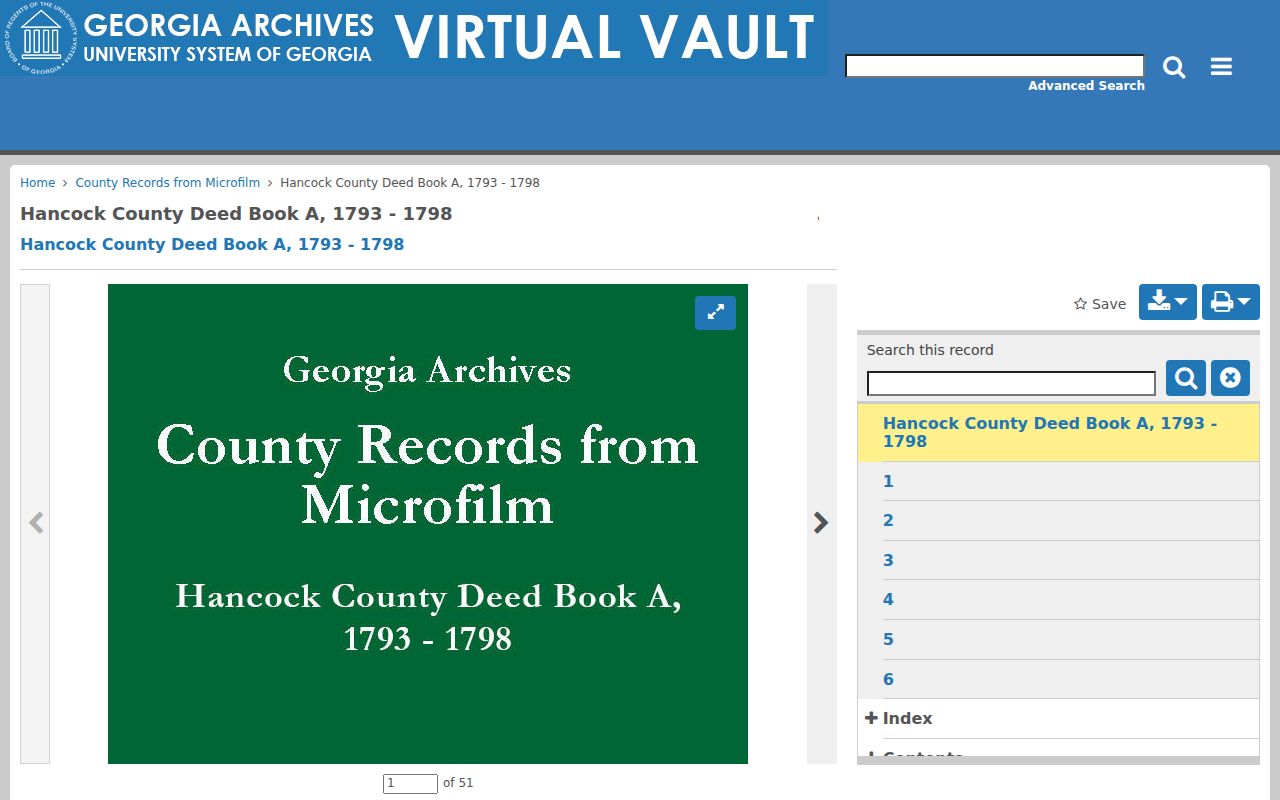
Keep the catalog notes alongside what the page actually shows. When a cited page is missing or unreadable, mark the lead unresolved instead of guessing a name.
Estate Records Can Bridge Hancock County Previous Owners
A tidy sale-to-sale chain often stops cold. The break usually comes at an executor's deed, an administrator's deed, a partition, a life estate, or a bare estate reference. Re-run the search with the same names plus fiduciary wording, and follow any probate or court citation the deed itself supplies. The Virtual Vault holds Hancock estate-record leads from 1839 through 1843, along with Superior and Inferior Court minutes, execution dockets, writ records, and Justice of the Peace material. The Hancock Probate Court at 12630 Broad Street can point you to record series still held locally. A court minute or estate index only bridges the gap; the conveyance must still match the tract. Historical Society finding aids add indexed Court of Ordinary Minutes for 1799-1817, 1817-1837, and 1838-1863, plus Inferior Court Minutes covering 1809-1833. Treat a volume and page as a lead. Then seek the official minute, estate paper, or deed itself. A private index is never the final record.
Plats Keep Hancock County Former Owners on the Same Land
A name by itself can mislead. One Hancock County grantor may have held several tracts. That same person may also have conveyed only part of a single parcel. When tracing former owners, copy the full legal description from every deed: lot, block, subdivision, acreage, metes-and-bounds calls, watercourses. Include any plat reference too. A corrective deed can later replace one description without conveying the entire parcel again. The details matter.
Lake Sinclair frontage raises the stakes. Access roads, shoreline easements, flood context, covenants, and recorded plats can all change what a short parcel label seems to describe. Aerial imagery shows the water, but it proves nothing about those rights.
Hancock County Newspapers Restore Lost Search Terms
Sparta Public Library keeps a genealogy collection with a microfilm machine, Sparta News-Plaindealer reels, and a digitized newspaper archive covering 1878-2015. Old legal notices can name an executor, an auction, a plantation, a former road name, or a courthouse event that no modern parcel card mentions. That makes newspapers a strong lead source for Hancock County ownership puzzles.
The Georgia Historic Newspapers collection goes further back. Its titles include The Missionary from 1821-1825, a Hancock weekly journal from 1869-1870, and Sparta papers from 1874. Names and phrases found there can be taken back to the official deed books or court records. Newspapers alone do not prove former ownership.
Old Hancock Tax Digests Are Clues, Not Deeds
The Archives lists Hancock County tax digests for 1794 and 1796 as unindexed. The 1812 and 1840 digests are indexed. A digest places a taxpayer, acreage, district, value, or classification in a historical snapshot. That snapshot can help bridge a hard research period.
Still, treat a digest entry with care. The taxpayer was not always the fee-simple owner. An entry could omit or combine interests. Confirm against deed books, court minutes, estate files, land-lottery records, maps, and legal notices before adding anyone to a chain of title. The 1794 Hancock tax digest image shows the archival format.
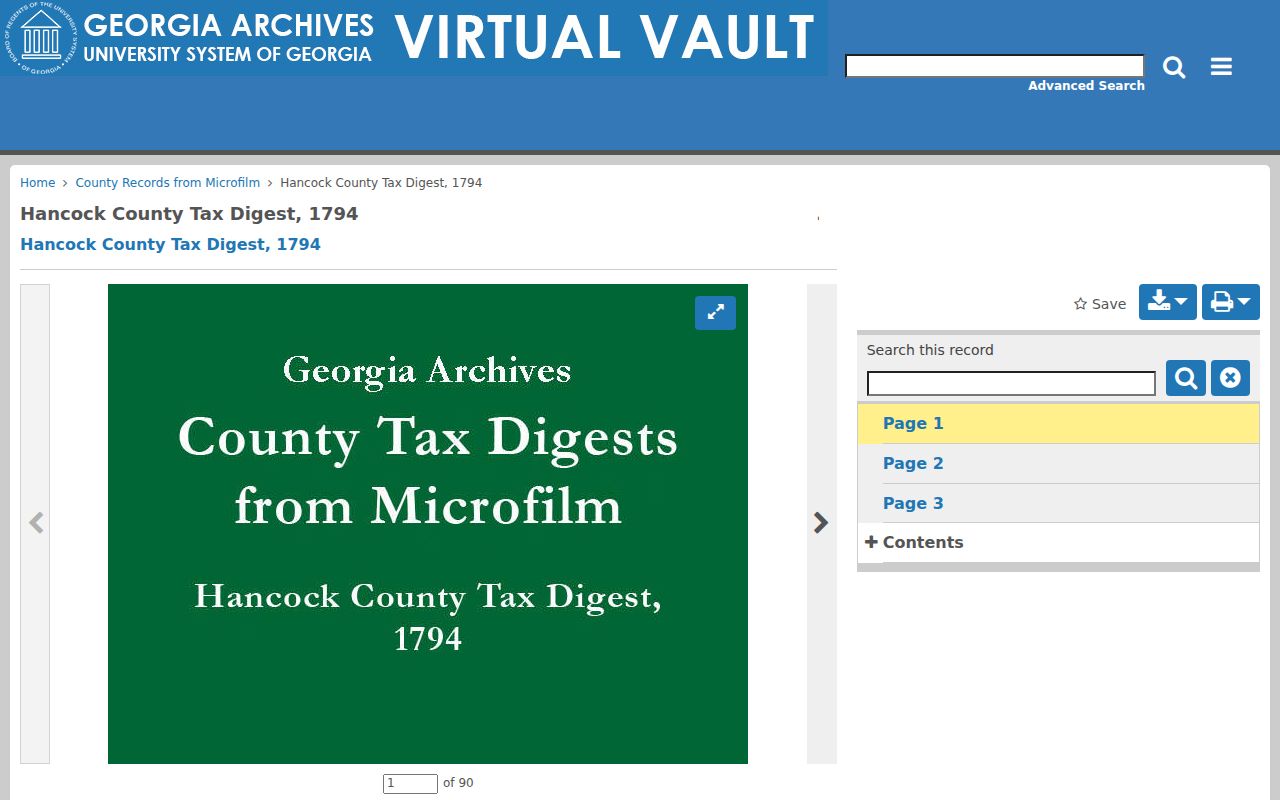
Note: Record the digest year and page as a supporting clue, and keep the corresponding deed link separate in your notes.
How Far Hancock County Ownership History Can Go
Two questions get confused here. The earliest known county book is one fact. The earliest deed for one specific tract is another. Archives evidence takes selected Hancock volumes back to the 1790s. A parcel-specific chain can still stop sooner. Missing pages, illegibility, an estate gap, or a tract split can break the line. So can an unresolved earlier reference.
For older material, try the Clerk counter. Also try the Georgia Archives Virtual Vault, the Sparta-Hancock County Library, and Historical Society finding aids. An Open Records Act request works best when it asks for an existing book, index page, instrument, or docket entry. Asking an office to build a family or title history rarely goes anywhere.
Keep a working log as you go. It should preserve the source URL, office, search date, and exact terms. Include geographic scope, series dates, and record or image number. Add a short confidence label too. That audit trail lets another person tell a verified link from a plausible clue. It also helps them return directly to a damaged or unindexed volume.
Lawful use. Research former owners for house history, estate work, recorded-rights questions, or purchase diligence. Never use public records to stalk, harass, threaten, or expose protected address information.